
- You are here:
- Home
- About Symbols
- Why consistency matters: the case for using one symbol set
Why consistency matters: the case for using one symbol set when supporting meaning through text
An article by Lisa Pinkerton, Head of Education at Widgit Software
In the field of accessible communication, symbol-supported text is a powerful bridge, linking written language with visual meaning. Whether used in classrooms, healthcare settings or for public information, symbols can reduce barriers and support understanding for a wide range of learners. There is, however, a critical and sometimes overlooked factor that determines how effective this support really is: consistency. Specifically, the consistent use of a single symbol set.
The illusion of interchangeability
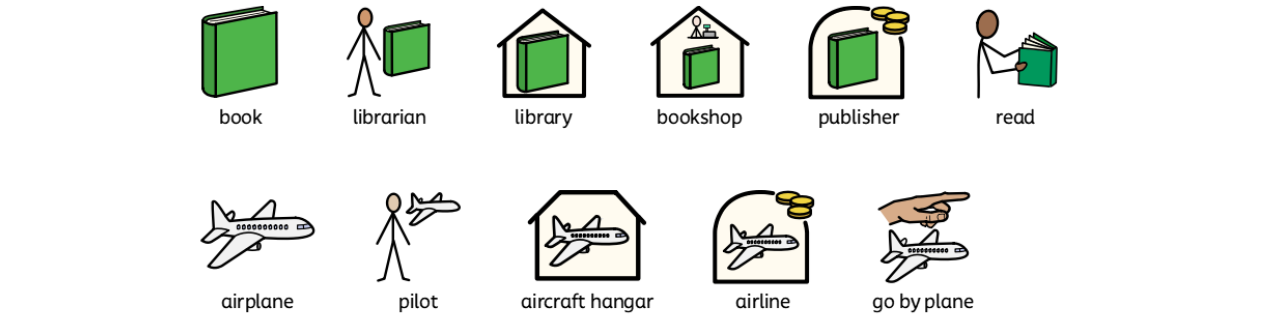
At first glance, symbol sets may appear interchangeable. A ‘drink’ symbol in one system may look broadly similar to a ‘drink’ symbol in another. But beneath the surface, each symbol set is its own structured visual language built on different rules and ways of encoding meaning.
Research and professional guidance in augmentative and alternative communication (AAC) demonstrates that effective symbol usage comes from repeated exposure and stable associations. When a child sees the same symbol paired with the same word over time, they begin to internalise that connection.
Introduce different symbols for the same concept, and that mapping becomes less stable.
Evidence-informed AAC guidance notes that inconsistent symbol use can:
- slow down learning
- increase cognitive load
- lead to errors in interpretation
- reduce independence in navigating text
In other words, inconsistency doesn’t just create mild confusion, it actively interferes with the learning process.
Analogy: multiple languages at once
Imagine learning to read English, but every few words, the language switches. A sentence might begin in English, shift into Spanish, then finish in German.
Even if you had some familiarity with all three languages, processing that sentence would require constant mental switching, such as identifying which language is being used, retrieving the correct vocabulary system, and re-establishing meaning each time.
For a fluent multilingual adult, this would be tiring. For a child still learning language, it would be overwhelming. This is effectively what happens when we mix symbol sets. Each symbol system has its own ‘grammar’ of visuals, including how actions are represented, how abstract ideas are depicted, and how tense, plurality or relationships are shown. When we mix systems, we are asking the learner to navigate multiple visual languages simultaneously, often without explicitly teaching the differences.
Symbol learning and cognitive load
Cognitive load theory explains that learning is most effective when unnecessary mental effort is reduced. For early symbol users, a significant portion of cognitive effort is already dedicated to:
- understanding that symbols represent meaning
- linking symbols to spoken or written words
- scanning and locating symbols in text
When we introduce multiple symbol sets, we add an extra layer:
- “Which type of symbol is this?”
- “Have I seen this version before?”
- “Does this represent the same thing as the other one I learned?”
Research shows that younger or less experienced users are particularly sensitive to this variability. For example, they are more likely to interpret symbols inconsistently, rely heavily on familiar visual patterns, or struggle to generalise across different representations. Consistency, therefore, is not just helpful; it is foundational.
Analogy: signage in an airport
Consider an international airport.
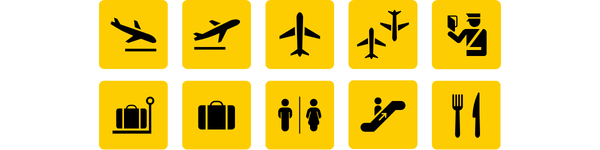
Airports are complex environments with high stakes. Passengers must navigate quickly, often under pressure, and sometimes in unfamiliar countries. To support this, airports rely heavily on standardised signage systems:
- the same icon for toilets
- the same symbol for baggage reclaim
- consistent visual cues for exits, security, and gates
Now imagine a different scenario.
At one end of the airport, ‘Departures’ is marked with a standard icon. At another, it’s a cartoon character. Elsewhere, it is represented by a completely different style again. Some signs are realistic, others abstract, and others symbolic in unfamiliar ways.
Even confident travellers would slow down. Some would make mistakes. Stress would increase.
For someone already struggling with language or processing, navigation could become extremely confusing.
Symbol-supported text works in much the same way. When symbols are consistent, they act like reliable signage; quickly recognised and easily interpreted. When they vary, the reader must stop, interpret, and re-learn.
When variation becomes a barrier
There is also a cultural parallel in everyday life.
Restaurants, for example, sometimes use playful or humorous signage for things like toilets. A toilet sign might be represented by a throne, for example.
These can be amusing, but they rely on shared cultural knowledge and inference. For someone unfamiliar with the joke, the meaning is not immediately clear.
In accessible communication, we cannot rely on inference.
Symbol-supported text is not decoration; it is a core part of meaning-making. If a symbol requires interpretation beyond recognition, it is no longer fully accessible.
Evidence suggests that symbol learning depends on stable repeated pairings between symbol and meaning.
- Symbol learning depends on repeated, stable pairings between symbol and meaning
- Inconsistent representations can slow acquisition and increase errors
- Cognitive load increases when learners must process multiple representations for the same concept
Using a single, consistent symbol set ensures that visual cues remain predictable, cognitive load is minimised, and learning is reinforced rather than disrupted.
The goal is not to expose learners to as many languages as possible at once. It is to give them a clear, consistent system they can understand, trust and eventually use independently.

 Widgit Symbols Schema
 Guide to Good Symbol Content